7 Signs Your Water Heater Is About to Fail
Water heaters don't usually fail out of nowhere. They warn you , rusty hot water, popping from the tank, a lukewarm third shower, a wet spot under the base. Here are the 7 signs I watch for on every call in Millersville, and what each one really means.
Published · By Marcus Hartman
Seven signs tell you a water heater's about to go: rusty hot water, popping or rumbling, lukewarm showers, water pooling at the base, age over 10 years, rising gas or electric bills, and pilot light problems. Spot two or more in a Millersville tank and it's replacement time, not repair. Here's what each one actually means.
1. Rusty or brown hot water
Run the hot tap in a tub or utility sink. If the water's got an orange or brown tint, and the cold runs clear, the rust is coming from inside your tank. The anode rod's done and the tank lining's started to corrode. On Millersville-area well water , anywhere outside the borough's municipal lines , this shows up by year 4-6 instead of 8-10. Catch it early and a $250-$400 anode swap buys you another 3-4 years. Catch it late and you're looking at a replacement , once the tank wall's pitted, it's going to leak.
2. Popping, rumbling, or crackling from the tank
That sound's sediment. Hard water lays mineral scale on the bottom of the tank, the burner (or lower element on an electric) heats through it, and water flashes to steam between the grains. Pop, pop, pop. Rapho Twp and Conoy farmhouses on well water get it loudest , I've heard tanks sound like microwaved popcorn. A drain-and-flush at $225-$375 will fix it if you catch it early. If the tank's been popping for 2 years already, the scale's cemented, and the drain valve won't even open. At that point flushing's a waste , plan a replacement.
3. Lukewarm water or hot that runs out fast
Shower #2 cold? Hot tap running lukewarm on full? Something's up. On a gas tank, the burner or gas valve's dying , the flame isn't carrying the water to 120°F. On an electric tank, it's almost always the lower element , the top one heats the top half of the tank, so you get one hot shower before the water goes cold on refill. A lower element swap runs $225-$375. If both elements and both thermostats are shot, you're past the point where repair makes sense on a 10+ year tank.
4. Water pooling at the base of the tank
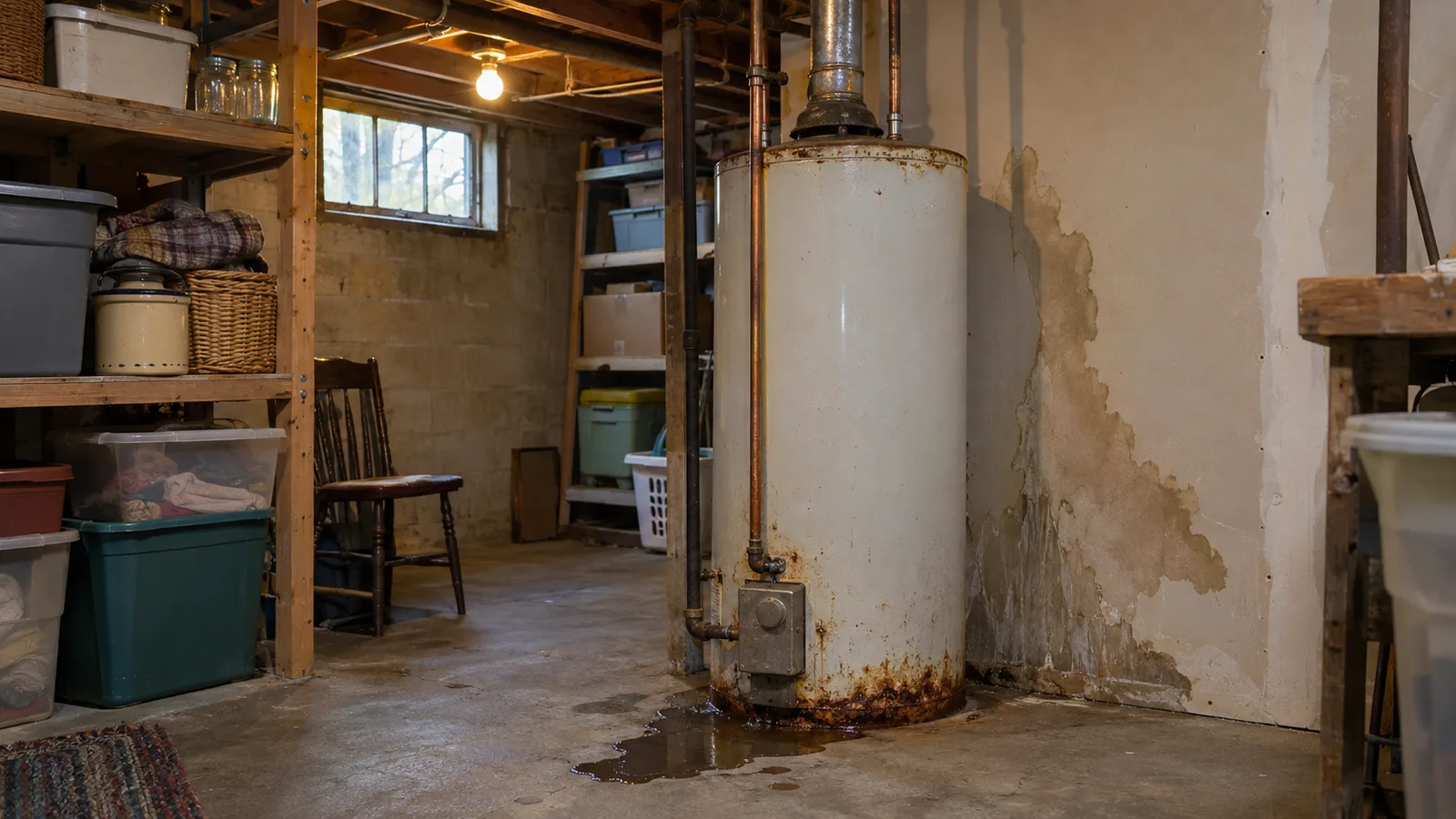
First , check it's not condensation (common in humid Lancaster County summers when the incoming water's 55°F and the basement air's 75°F and dripping on the cold inlet). Wipe the tank and floor dry, lay down newspaper, come back in 4 hours. If the paper's wet underneath the heater, the tank's cracked. Not fixable. Don't buy the big-box 'water heater sealant' tubes , they're a 48-72 hour stall at best. Shut the water and gas (or the breaker), drain it down below the leak, and call. A cracked tank is replacement, full stop.
5. Age over 10 years
Check the serial number sticker on the side. First one or two characters usually code month and year , a Rheem reading 'G09' is July 2009 (older formats vary by brand, look up the chart). Gas and electric tanks are built for 10-13 years. Tankless units run 18-20. On Millersville well water, shave 2 years off the tank number , the hard water chews through anodes fast. If your tank's over 12, every repair call's a judgment call: is the fix worth it, or are you pouring money into a unit that'll die by next winter's cold snap?
6. Climbing gas or electric bills
A healthy 40-gallon gas tank costs roughly $20-$35/month to run for a family of four in Lancaster County. A 40-gallon electric is closer to $40-$60/month at current PPL rates. If your bill jumped 20-30% and nothing else changed , no new appliance, no new baby taking long baths , the heater's working harder to deliver the same hot water. Sediment, a dying element, or a cracked dip tube are the common causes. A diagnostic call at $75-$150 pays for itself inside a month if you catch it.
7. Pilot light won't stay lit or burner won't ignite
Standing-pilot gas heaters , common in 1990s Millersville basements , usually have a dying thermocouple when the pilot won't hold. $180-$275 swap and you're done. Newer electronic-ignition heaters with a failed igniter are a different animal , $300-$500 depending on the control board. If the pilot's fine but the main burner won't light, the gas valve is often the problem, and on a 12+ year tank that's a $450-$700 part plus labor. That's the point where I usually tell folks to put the money into a new heater instead.
What to do if you spot two or more signs
Shut the thermostat to 120°F so the tank's not cycling hard. Put a drip pan under it if there isn't one. Don't ignore a pooling base , close the cold inlet valve and call. For a single sign on a heater under 10 years, a repair's usually the right move. For two or more signs, or a heater past year 12 on borough water or year 10 on well water, replacement's the honest answer. Millersville winters hit hard in January and February , don't let a dying heater fail during a 22°F cold snap when every plumber in Lancaster County's booked three days out.
If you're seeing any of these on a tank in Blue Rock, Pucillo Hills, or anywhere else in 17551, give me a call before it turns into a flooded basement.