Winterizing Your Water Heater in Lancaster County
Lancaster County freezes hard from late November through early March. Here's how to winterize a water heater , pipe wrap on exposed lines, a 120°F thermostat, an insulation blanket on a cold-basement or garage unit, and what to do if a pipe freezes near the tank.
Published · By Marcus Hartman
To winterize a water heater in Lancaster County: wrap exposed supply lines with foam pipe insulation, set the thermostat to 120°F, put an insulation blanket on tanks in garages or uninsulated basements, and open a trickle on the farthest hot tap if a hard freeze drops temps below 15°F. That's the short version. Below's the full playbook , because Lancaster winters run from late November through early March, and a dead heater at 2 a.m. in February is a bad night.
When does Lancaster County actually freeze?
Straight from the pattern around Millersville and the surrounding townships. Late November brings the first hard frost , low 20s overnight, 30s during the day. December averages 25-38°F. January and February are the brutal stretch , overnight lows 15-25°F, daytime holding in the high 20s, with 2-3 cold snaps dropping below 10°F. March warms up but we still get hard overnight freezes through the first week or two. That's roughly 100 nights below freezing. Your heater's working through every one of them.
Why winterizing matters here specifically
Two Lancaster County realities make this more important than most folks think. First , a lot of local homes have water heaters in uninsulated basements, crawlspaces, or garages. The 1810s brick row houses in Marietta, the 1920s stock around Millersville University, the farmhouses out past Rock Ford Plantation , all cold-basement houses. The tank's fighting a 50-55°F basement air temp all winter. Second , anyone outside the borough service areas is on well water coming in at 45-50°F in January. Your heater's raising that water 70-75°F to hit 120°F at the tap. More work, longer burn times, higher bill, faster wear.
Set the thermostat to 120°F , no higher, no lower
This one's non-negotiable. 120°F is the EPA and plumbing code recommendation, and it's the right number. Lower and you're risking Legionella bacteria growth, especially on heaters that sit idle (vacation homes, rarely-used cottages). Higher and you're wasting 10-15% on your energy bill and putting kids and seniors at scald risk , 140°F water can give a third-degree burn in 5 seconds. If you're a well-water household and sediment's an issue, I'd rather you flush the tank than crank the dial up to compensate. More temperature won't push past scale.
Insulation blankets , garage and cold-basement units only
A $25-$40 water heater blanket from any big-box store cuts standby heat loss by 25-45% on an older tank in a cold space. Install one if: your tank's in a garage, a crawlspace, an uninsulated basement, or against an exterior foundation wall. Skip it if: the tank's in a conditioned closet, the manufacturer label says 'do not insulate,' or it's a high-efficiency tank built after 2015 with factory R-16+ insulation (adding more does nothing). On a gas unit, do not cover the top, the thermostat access panel, the burner intake at the bottom, or the flue. Cover those and you've got a carbon monoxide risk.
Pipe wrap on exposed hot and cold lines
Foam pipe insulation , the slit-tube kind , is the cheapest winter upgrade going. $1.50-$3 a stick at Boyer's Hardware or Home Depot. Wrap every exposed hot and cold line near the heater, especially the first 6-10 feet coming off the tank where heat loss is worst. Pay attention to lines running through: unheated crawlspaces (common in older Lancaster County farmhouses), garage walls, basement band joists against exterior foundation, and any pipe within 12 inches of a drafty window or vent. In a 1920s stone-walled basement in Downtown Millersville, the band joists are a known freeze spot.
What to do if a pipe freezes near the water heater
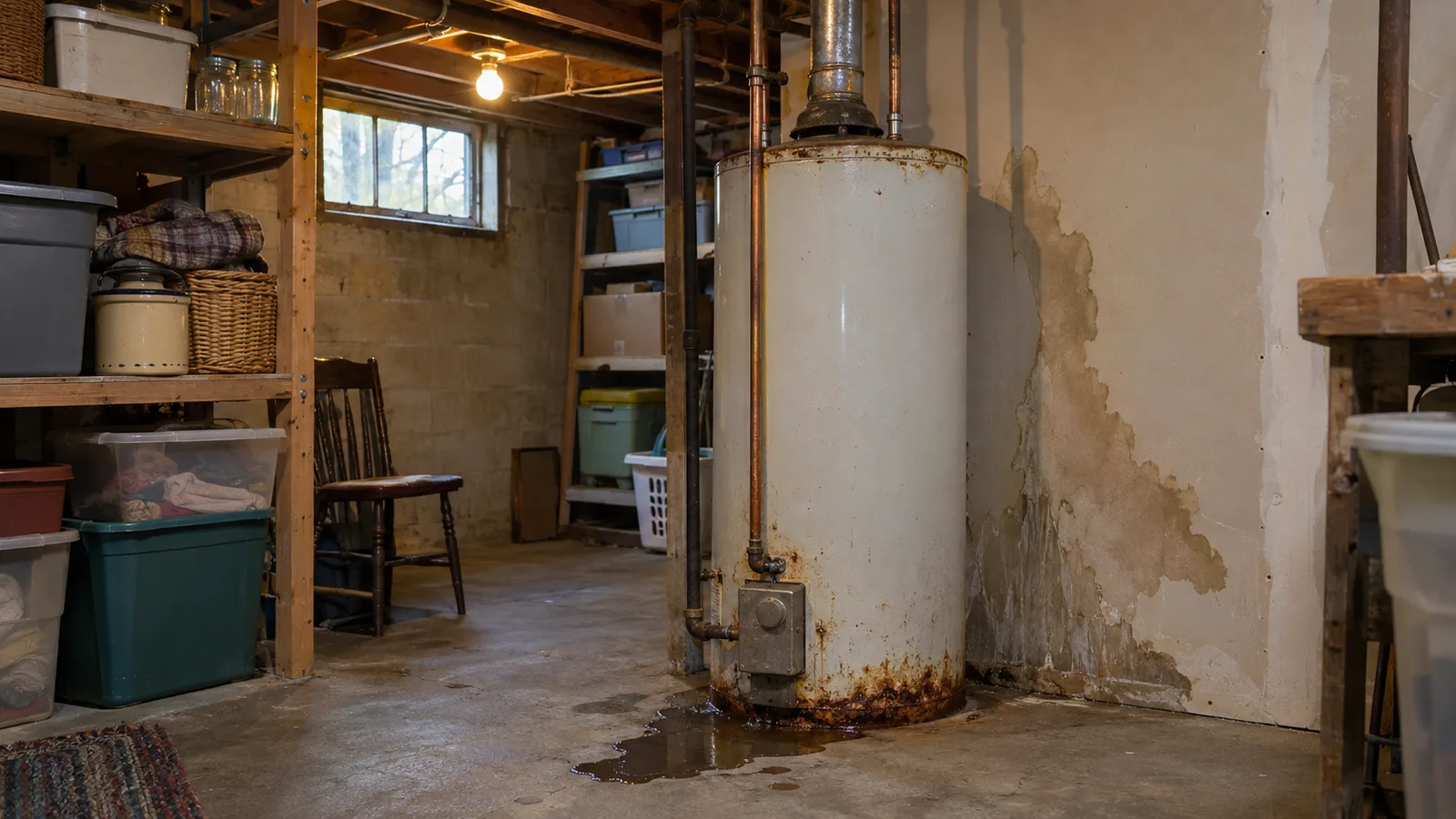
First , don't panic, and don't use an open flame. Shut the water off at the main. Open the faucet the frozen line feeds so pressure can escape as the ice thaws. Thaw with a hair dryer, a heat lamp, or wrapped heat tape , never a propane torch. If the pipe's bulged, cracked, or dripping once it thaws, shut the tank's gas or electric, drain it below the leak, and call. If the frozen section is on the water heater's T&P discharge line, that's a safety issue , the pressure relief valve can't open if the discharge line's iced solid. Kill power to the tank and call for help.
Well-water homes: an extra step
If you're on a well , anywhere outside the Millersville Borough Authority, Columbia Water, Manheim Borough, or Elizabethtown service areas , winter's harder on your heater. Cold-weather wells deliver water at 42-48°F in January versus 55°F from borough lines. Your tank's working 10-15° harder. Two things help. One , do a tank flush in October or early November before the heavy freeze. Scale blocks heat transfer; a flushed tank recovers faster. Two , if your well pump house sits above the frost line in an exposed shed or crawlspace (common in Rapho and Donegal Twp farms), insulate it and run a thermostat-controlled heat lamp or heat tape on the supply line to the house.
Before the first hard freeze , a 15-minute checklist
Walk through this in early November. Test the T&P valve by lifting the lever , water should discharge, then stop cleanly. If it drips after, that's a $25 valve swap, do it now. Look under the tank for any wet spots or rust bloom. Check the drain valve by cracking it a quarter turn into a bucket , should flow clear, not rust-orange. Confirm the thermostat's at 120°F. Check the flue on a gas unit , hold a lit match near the draft hood during a burn cycle, flame should pull in, not push out. Confirm the drip pan has a drain line going somewhere, not a dead-end stub. Fifteen minutes. Could save you a flooded basement in January.
If you want me to do that pre-winter walk-through before Thanksgiving, give the shop a call , I'd rather catch a problem in October than roll out on a 2 a.m. emergency in February.